Monday, August 4, 2025

When All Creation is Subject to Christ

In First Corinthians 15, St. Paul unfolds for us the gospel and its cosmic dimension. He begins: “Now, brothers and sisters, I want to remind you of the gospel I preached to you, which you received and on which you have taken your stand. By this gospel you are saved, if you hold firmly to the word I preached to you. Otherwise, you have believed in vain. For what I received I passed on to you as of first importance: that Christ died for our sins according to the Scriptures, that he was buried, that he was raised on the third day according to the Scriptures" (1 Corinthians 15:1-4). In the balance of the chapter, he shows the scope and significance of the gospel, and its final resolution:

Then the end will come, when he hands over the kingdom to God the Father after he has destroyed all dominion, authority and power. For he must reign until he has put all his enemies under his feet. The last enemy to be destroyed is death. For he “has put everything under his feet.” Now when it says that everything has been put under him, it is clear that this does not include God himself, who put everything under Christ. When he has done this, then the Son himself will be made subject to him who put everything under him, so that God may be All in All. (1 Corinthians 15:24-28) 

The gospel Paul preaches is not merely a local or regional concern but is without geographical boundaries — indeed, it knows no cosmic limitations whatsoever. In several other of his epistles, Paul lays out the “big picture,” the express and eternal purpose and pleasure of God accomplished through Christ.

For the creation waits in eager expectation for the children of God to be revealed. For the creation was subjected to frustration, not by its own choice, but by the will of the one who subjected it, in hope that the creation itself will be liberated from its bondage to decay and brought into the freedom and glory of the children of God. We know that the whole creation has been groaning as in the pains of childbirth right up to the present time. Not only so, but we ourselves, who have the firstfruits of the Spirit, groan inwardly as we wait eagerly for our adoption to sonship, the redemption of our bodies. (Romans 8:19-23) 

He made known to us the mystery of his will according to his good pleasure, which he purposed in Christ, to be put into effect when the times reach their fulfillment — to bring unity to all things in heaven and on earth under Christ. (Ephesians 1:9-10) 

 For God was pleased to have all his fullness dwell in him, and through him to reconcile to himself all things, whether things on earth or things in heaven, by making peace through his blood, shed on the cross. (Colossians 1:19-20)

It is the salvation, the redemption, the deliverance, of all of heaven and earth; which is to say, of everyone and everything. All are brought to unity and summed up in our Lord Jesus Christ. “And God placed all things under his feet and appointed him to be head over everything for the church, which is his body, the fullness of him who fills everything in every way” (Ephesians 1:22-23). Christ is the one who fills everything in every way, and the Church, which is the Body of Christ, is that fullness of him. In this way, all creation becomes the Body of Christ, and so does God become All in All.

We find this understanding echoed in the early Church Fathers. For example, in St. Irenaeus of Lyons, in Origen of Alexandria, and in St. Athanasius of Alexandria: 

For the Creator of the world is truly the Word of God: and this is our Lord, who in the last times was made man, existing in this world, and who in an invisible manner contains all things created, and is inherent in the entire creation, since the Word of God governs and arranges all things; and therefore He came to His own in a visible manner, and was made flesh, and hung upon the tree, that He might sum up all things in Himself. (St. Irenaeus, Against Heresies 5.18.3)

If, then, that subjection be held to be good and salutary by which the Son is said to be subject to the Father, it is an extremely rational and logical inference to deduce that the subjection also of enemies, which is said to be made to the Son of God, should be understood as being also salutary and useful; as if, when the Son is said to be subject to the Father, the perfect restoration of the whole of creation is signified, so also, when enemies are said to be subjected to the Son of God, the salvation of the conquered and the restoration of the lost is in that understood to consist. (Origen, De Principiis 3.5.7) 

For the Lord touched all parts of creation, and freed and undeceived them all from every deceit. As St. Paul says, “Having put off from Himself the principalities and the powers, He triumphed on the cross,” so that no one could possibly be any longer deceived, but everywhere might find the very Word of God. For thus man, enclosed on every side by the works of creation and everywhere — in heaven, in Hades, in men and on the earth, beholding the unfolded Godhead of the Word, is no longer deceived concerning God, but worships Christ alone, and through Him rightly knows the Father. (St. Athanasius, On the Incarnation, 45)

Christ is intimately and inextricably 
united with all creation. It is as all creation 
is subject to Christ, and Christ is subject 
to the Father, that God is All in All.

Saturday, August 2, 2025

The Incarnation As Mutual Indwelling

The Incarnation is the mystery of God and humanity dwelling together in unbroken, inseparable union. Christ has taken on our full humanity, not as a vessel or garment to be cast aside but as that which he has become, without in any way detracting from his full divinity. For “The Word became flesh and made his dwelling among us. We have seen his glory, the glory of the one and only Son, who came from the Father, full of grace and truth” (John 1:14). This union is not a blending or confusion of natures but a co-inherence — a mutual indwelling — such that wherever the Son is, both divinity and humanity are fully present. St. Maximus the Confessor speaks of this great and encompassing mystery:

By his gracious condescension God became man and is called man for the sake of man and by exchanging his condition for ours revealed the power that elevates man to God through his love for God and brings God down to man because of his love for man. By this blessed inversion, man is made God by divinization and God is made man by hominization. For the Word of God and God wills always and in all things to accomplish the mystery of his embodiment. (Ambigua 7)

“God became man” in order to save lost man, and — after he had united through Himself the natural fissures running through the general nature of the universe ... to fulfill the great purpose of God the Father, recapitulating all things, both in heaven and on earth, in Himself, in whom they also had been created. (Ambigua 41)

The deified person, while remaining completely human in nature, both in body and soul, becomes wholly God in both body and soul, through grace and the divine brightness of the beatifying glory that permeates the whole person. (Ambigua; Patrologia Graeca 91, 1088)

In the Incarnation, Christ did not become merely one of us but one with us. He is not simply one man among many but the one in whom God’s eternal purpose to bring unity to all in heaven and on earth — all are summed up in Christ (Ephesians 1:9-10). Christ is in all and all are in Christ. This mutual indwelling is the heart of salvation. 

Christ has united human nature to himself, and so is present in all humanity, sustaining each one of us. In him, humanity is healed, restored, and brought into union with God. As St. Gregory of Nazianzus says, “That which he has not assumed he has not healed; but that which is united to his Godhead is also saved” (Epistle 101, To Cledonius).

The Co-Inherence of Divinity and Humanity in our Lord Jesus Christ means that salvation is not some abstract, legal declaration, but a real and transformative union. Through such tangible means as baptism and the Eucharist, we are joined to Christ’s death and resurrection, and by the Holy Spirit we share in his divine life. “It is no longer I who live,” says Paul, “but Christ who lives in me” (Galatians 2:20). “His divine power has given to us all things that pertain to life and godliness, through the knowledge of him who called us by glory and virtue, by which have been given to us exceedingly great and precious promises, that through these you may be partakers of the divine nature” (2 Peter 1:3-4).

The Incarnation is the co-inherence,
the interpenetration, the mutual indwelling
of divinity and humanity, of God and humankind.
It means Christ is in all and all are in Christ.

Wednesday, July 30, 2025

Some Moment Other Than the Cross

The Cross is where the world is judged and the sins of the world forgiven. For God was in Christ reconciling the world to himself, not counting our sins against us (2 Corinthians 5:19). Christ is “the atoning sacrifice for our sins, and not only for ours but also for the sins of the whole world” (1 John 2:12). Even as he was being crucified, our Lord Jesus Christ prayed for us all, “Father, forgive them, for they know not what they do” (Luke 23:34).

The Moment of the Cross is the only true moment, the only moment in which we belong — the only moment there is. To turn away from this moment is to turn toward non-being. To embrace this moment is to embrace Christ, who draws us to himself. Looking to this moment, Lord Jesus said, “Now is the time for judgment on this world; now the prince of this world will be driven out. And I, when I am lifted up from the earth, will draw all people to myself” (John 12:31-32).

When we do not forgive others, or ourselves, 
we are living in some moment other than 
that of the Cross, for the Cross is where 
the forgiveness of all is revealed.

Friday, July 25, 2025

Forgiveness is All of One Piece

St. Paul tells us that God was in Christ reconciling the whole world to himself, not counting our sins against us (2 Corinthians 5:19). This forgiveness by which we are forgiven is all of one piece with the forgiveness by which we forgive each other. All humankind is one, also, for there is only one human nature, only one human being, of which we all partake. Through the Incarnation, the Human Being in which we all participate is defined in Jesus Christ, who reveals for us exactly what it is to be human. And in him we are all forgiven from before the foundation of the world.

Through our participation in Jesus Christ, the only Human Being there is, we are intimately and inextricably bound to each other, and the implication runs deep. We belong to each other so deeply that none of us can finally be whole until each one of us is finally whole. So we must learn to forgive one another, allowing the forgiveness of God, revealed in Jesus Christ, to have its full work in us. Until we do, we will not be whole. In a very real way, and as the ancient Desert Fathers would say, “My brother is my salvation.”

Wednesday, July 23, 2025

Divine Grace Through Tangible Means

Christ is the Creator of all. Everything in heaven and on earth is his handiwork and reveals him. It is no wonder, then, that he would minister divine grace to us through tangible things. Indeed, through the tangibility of created matter, he ministers salvation to us. For salvation is not abstract and disembodied, separating spirit from body, but it is actually and transformative. God ministers grace to us in tangible ways and through such means as water, oil, bread and wine. These are not mere symbols but become sacramental elements through which God actually accomplishes something in us, manifesting salvation to us.

In the Water of Baptism, we are buried with Christ, baptized into his death, so that just as Christ has been raised from the dead, we too may live in newness of life, the life of Christ in us.

Don’t you know that all of us who were baptized into Christ Jesus were baptized into his death? We were therefore buried with him through baptism into death in order that, just as Christ was raised from the dead through the glory of the Father, we too may live a new life. (Romans 6:3-4)

In the Oil of Anointing, Christ ministers healing to us, just as he sent the disciples out to preach, with authority to expel demons and heal diseases. Presbyters/Priests were likewise given authority to anoint with oil for healing.

They drove out many demons and anointed many sick people with oil and healed them. (Mark 6:13)

Is anyone among you sick? Let them call the elders of the church to pray over them and anoint them with oil in the name of the Lord. (James 5:14)

The Bread and Wine of Eucharist have true participation in the Body and Blood of Christ, and so we, who are many, become the Body of Christ.

Is not the cup of thanksgiving for which we give thanks a participation in the blood of Christ? And is not the bread that we break a participation in the body of Christ? Because there is one loaf, we, who are many, are one body, for we all share the one loaf. (1 Corinthians 10:16-17)

Friday, July 18, 2025

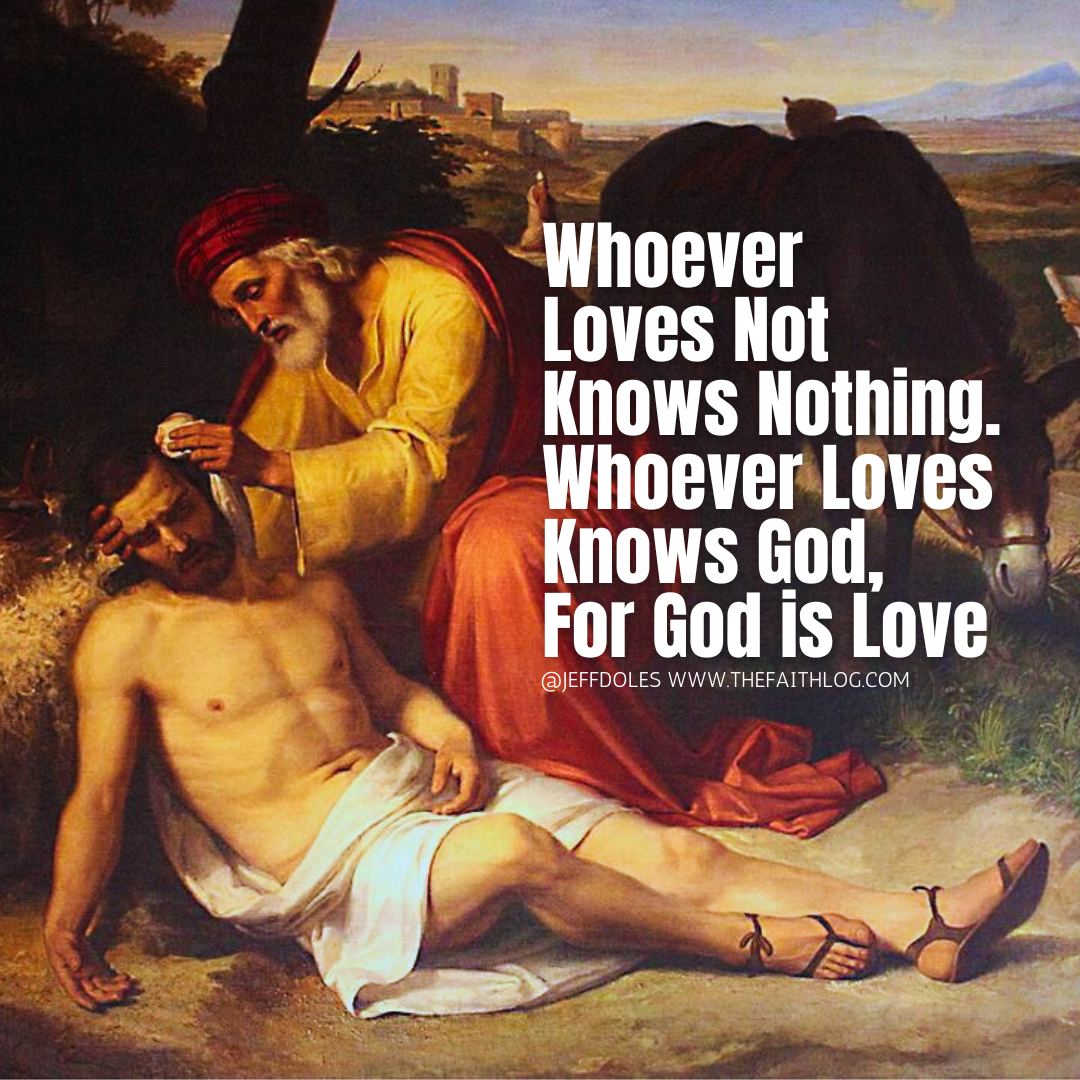
Whoever Loves Not Knows Nothing

God is Love. Where Love is, there God is. The Love of God is not abstract but is very tangibly revealed in the self-giving of our Lord Jesus Christ upon the Cross. This is the love God desires to reveal in us and through us — self-giving, other-centered, cross-shaped. St. Paul speaks quite splendidly and famously, in 1 Corinthians 13, on the nature of Love.

St. John the Theologian also brings us some important insights in the middle three chapters of First John. He tells us quite plainly that whoever loves has been born of God and knows God, and whoever does not love does not know God.

Dear friends, I am not writing you a new command but an old one, which you have had since the beginning. This old command is the message you have heard. Yet I am writing you a new command; its truth is seen in him and in you, because the darkness is passing and the true light is already shining. Anyone who claims to be in the light but hates a brother or sister is still in the darkness. Anyone who loves their brother and sister lives in the light, and there is nothing in them to make them stumble. But anyone who hates a brother or sister is in the darkness and walks around in the darkness. They do not know where they are going, because the darkness has blinded them. (1 John 2:7-11)

We know that we have passed from death to life, because we love each other. Anyone who does not love remains in death. (1 John 3:14)

Dear children, let us not love with words or speech but with actions and in truth. This is how we know that we belong to the truth and how we set our hearts at rest in his presence: If our hearts condemn us, we know that God is greater than our hearts, and he knows everything. (1 John 3:18-20)

Dear friends, let us love one another, for love comes from God. Everyone who loves has been born of God and knows God. Whoever does not love does not know God, because God is love. (1 John 4:7-8) 

Whoever Loves Not Knows Nothing.
Whoever Loves Knows God,
For God is Love.

Wednesday, July 16, 2025

All of One Piece

Who and how we worship instructs our faith and informs how we live — and these cannot be separated. Even those who claim no faith nonetheless have an object of highest concern that functions as their deity. They have a pattern of rituals developed in service to such idols, which instructs their thoughts and reinforces the intents and purposes of their hearts. And so are their lives shaped and formed day by day.

Who we worship is not just a matter of doctrine — it is the foundation of our identity. To worship the Father, through the Son, and in the Holy Spirit is to anchor our lives in the One who is not only true and beautiful and good, but is Truth, Beauty, and Goodness itself.

But how we worship matters too. If our worship is full of awe, centered on the mystery of Christ, breathing the Scriptures with the Spirit of Life, we will be drawn into the divine fellowship of Father, Son and Holy Spirit. Our faith will be nourished with depth and clarity, illumined with the Light of God. But if our worship is casual, self-focused, empty of the sacred, our faith will easily wither into sentiment and we will be darkened by delusion.

Worship is not performance — it is formation. It teaches us who God is, who we are, and how the world, stripped of all delusion, is created to be: the Kingdom of God come, the will of God being done on earth as it is in heaven. In lifting our hearts to the Lord of All, we are shaped into people who do justice, love mercy and walk humbly with God. 

Lex Orandi, 
Lex Credendi, 
Lex Vivendi.

How we pray, 
how we believe, 
how we live is 
all of one piece. 

Monday, July 14, 2025

The Humble Expectation of Hope

Do not trust in yourself or in your own strength, but put your trust in the Lord. As the wise man said, “Trust in the LORD with all your heart and lean not on your own understanding; in all your ways submit to him, and he will make your paths straight” (Proverbs 3:5-6). 

This is humility and hope, to recognize our own weakness, inability and lack, that we may have all our confidence and expectation in God. St. Paul had a serious matter he was dealing with. “Three times I pleaded with the Lord to take it away from me. But he said to me, ‘My grace is sufficient for you, for my power is made perfect in weakness.’ Therefore I will boast all the more gladly about my weaknesses, so that Christ’s power may rest on me” (2 Corinthians 12:8-9). 

Hope is not a wishy-washy maybe-so-maybe-not affair; it is a peaceful anticipation, a joyful expectation. Lord Jesus counsels us to learn of him, for he is gentle and humble in heart, and in him there is the calm assurance of rest for the weary soul. “Come to me, all you who are weary and burdened, and I will give you rest. Take my yoke upon you and learn from me, for I am gentle and humble in heart, and you will find rest for your souls. For my yoke is easy and my burden is light” (Matthew 11:28-30). 

The psalm writer captures this very well, coming humbly before the Lord, lifting up his cry for help, and  watching in patient expectation:

Listen to my words, LORD, 
    consider my lament. 
Hear my cry for help, 
    my King and my God, 
    for to you I pray. 
In the morning, LORD, 
    you hear my voice; 
    in the morning I lay my requests 
    before you and wait expectantly. 

Let all who take refuge in you be glad; 
    let them ever sing for joy. 
Spread your protection over them, 
    that those who love your name 
    may rejoice in you. 
Surely, LORD, you bless the righteous; 
    you surround them with your favor 
    as with a shield. (Psalm 5:1-3, 11-12)

The secret of humility and hope is that they go together. 
In hope, there is humility, and in humility, there is hope. 

Friday, July 11, 2025

To Love is to Be

We are created in the image of God, who is Love. To be like God, who is Love. Created by Love for Love. To love is what it is to be like God. To love is what it is to be human. To love is what it is to be. This is revealed in Jesus Christ, who is the Image of the Invisible God, in whom all the fullness of divinity dwells in bodily form, and in whom we are made complete and become partakers of the divine nature. At the Cross, we see that the Love of God is Self-Giving, Other-Centered, Cross-Shaped.

One day the Pharisees got together, and one of them, an expert in the Law of Moses, asked Jesus which is the greatest commandment. Jesus answered: “‘Love the Lord your God with all your heart and with all your soul and with all your mind.’ This is the first and greatest commandment. And the second is like it: ‘Love your neighbor as yourself.’ All the Law and the Prophets hang on these two commandments” (Matthew 22:37-40).  

Everything in the world depends on Love — love for God and love for our neighbor — for God, the Creator of All Things, the Source of All Being, is Love. To turn away from God and one another is to turn away from Love. It is to turn inwardly upon ourselves — incurvatus in se — who cannot sustain our own being. And so it is a turn from being to non-being.

To Love is to Be. 
To Fail to Love is to Fail to Be. 
For God, Who is the Source 
of All Being, is
Love. 

Wednesday, July 9, 2025

Faith Looks Like Love

To have faith in our Lord Jesus Christ is to trust him — to entrust ourselves to him — and so it is to follow him, to do as he teaches and obey as he commands. And what does he command but to love. Love for God, love for one another, love for our neighbor, and love even for our enemies. This is what faith looks like, for faith works through love.

“Love the Lord your God with all your heart and with all your soul and with all your mind.” This is the first and greatest commandment. And the second is like it: “Love your neighbor as yourself.” All the Law and the Prophets hang on these two commandments. (Matthew 22:37-40) 

You have heard that it was said, “You shall lover your neighbor and hater your enemy.” But I say to you, love your enemies, bless those who curse you, do good to those who hate you, and pray for those who spitefully use you and persecute you, that you may be sons of your Father in heaven. (Matthew 5:43-45) 

A new command I give you: Love one another. As I have loved you, so you must love one another. By this everyone will know that you are my disciples, if you love one another. (John 13:34-35)

If I speak in the tongues of men or of angels, but do not have love, I am only a resounding gong or a clanging cymbal. If I have the gift of prophecy and can fathom all mysteries and all knowledge, and if I have a faith that can move mountains, but do not have love, I am nothing. If I give all I possess to the poor and give over my body to hardship that I may boast, but do not have love, I gain nothing. Love is patient, love is kind. It does not envy, it does not boast, it is not proud. It does not dishonor others, it is not self-seeking, it is not easily angered, it keeps no record of wrongs. Love does not delight in evil but rejoices with the truth. It always protects, always trusts, always hopes, always perseveres. Love never fails. But where there are prophecies, they will cease; where there are tongues, they will be stilled; where there is knowledge, it will pass away. (1 Corinthians 13:1-8) 

And now these three remain: faith, hope and love. But the greatest of these is love. (1 Corinthians 13:13) 

The only thing that counts is faith expressing itself through love. (Galatians 5:6)

Dear friends, let us love one another, for love comes from God. Everyone who loves has been born of God and knows God. Whoever does not love does not know God, because God is love. (1 John 4:7-8)

Monday, July 7, 2025

What It Is To Have Faith in Jesus Christ

Faith in Christ is different from faith in propositions about Christ. The latter makes faith nothing more than an abstraction, disembodied and detached from the person of Christ, and from relationship with Christ — because Christ is not the object of such faith. True faith in Christ is a living, dynamic, and personal relationship with Christ. 

Lord Jesus said, “I am the Way and the Truth and the Life. No one comes to the Father except through me” (John 14:6). To have faith in Jesus Christ is to follow him, for he is the Way. It is to yield to him, for he is The Truth. It is to live him, for he is The Life.

Friday, July 4, 2025

The Gospel Begins With Jesus Christ

The Gospel begins with Jesus Christ. He is what God meant when God said, “Let us make Humankind in Our image, and to be like Us.” He is the Image of the Invisible God, in whom all the Fullness of Divinity dwells in bodily form (Colossians 1:15; 2:9). By the Incarnation, he is the one Human Being, of which we all partake. He is what it means to be human, and in him we are made complete, and become partakers of the Divine Nature (Colossians 2:10; 2 Peter 1:4).

To be created in the image of God — which is to be truly human — is to be conformed to the image of Christ, who is the Image of the Invisible God. To be like God is to be like Christ, in whom all the fullness of divinity dwells in bodily form. 

God is Love. Self-giving, other-centered, cross-shaped Love. To be created in the image of God, and to be like God, is to love with the divine love, to live the life that is self-giving, other-centered and cross-shaped. The image of God is most profoundly revealed at the cross, where our Lord Jesus Christ shows us what it is to be God and so what it is to be human. 

The Gospel begins and ends with Jesus Christ, the Incarnate One, Crucified and Risen. For all in heaven and on earth are created by him, through him, for him and in him, and all hold together in him (Colossians 1:16-17), and the express, eternal purpose of God is to bring all in heaven and on earth to unity in Christ — all summed up and headed in Christ (Ephesians 1:9-10). If we begin with anything else, we make Christ and the Cross secondary.

Wednesday, July 2, 2025

An Interesting Thing About the Saints

An interesting thing about the great saints is that while others experienced them as holy, they experienced themselves as sinful. St. Paul said, “Here is a trustworthy saying that deserves full acceptance: Christ Jesus came into the world to save sinners — of whom I am the worst” (1 Timothy 1:15). And Lord Jesus said, “It is not the healthy who need a doctor, but the sick. I have not come to call the righteous, but sinners to repentance” (Luke 5:31-32). The following story is told of Abba Sisoes (d. 429), one of the great Desert Fathers of the ancient Egyptian desert (his feast day is observed on July 6):

When Abba Sisoes was about to die, and the fathers were sitting with him, they saw that his face was shining like the sun. He said unto them, “Behold, Abba Anthony has come.” After a little while he said again, “Behold, the company of prophets has come,” and his face shone twice as bright. Suddenly, he became as one speaking with someone else, and the fathers sitting there asked him, “Show us with whom you are speaking, father.”

Immediately, Abba Sisoes said to them, “Behold, the angels came to take me away and I asked them to leave me so that I might tarry here a little longer and repent.” And the old men said unto him, “You have no need to repent, father.” And Abba Sisoes said to the fathers, “I do not know in my soul if I have rightly begun to repent,” and they all realized that the old man was perfect.

Then, suddenly, his face beamed like the sun and all who sat there were afraid and he said to them, “Look! Look! Behold, the Lord has come and he says, ‘Bring unto me the chosen vessel which is in the desert,’” and he at once delivered up his spirit and became like lightning and the whole place was filled with a sweet fragrance.*

Therefore, let us not lose heart. Let us gladly own ourselves sinners, that we may be cleansed by our Lord Jesus Christ and know our true identity in him. Let us gladly confess our lostness, that we may know our true home in him. Let us gladly embrace our death, that we may know our true life in him. Amen.

* The Paradise of the Holy Fathers, Vol 2, translated by E.A. Wallis Budge, (Seattle, WA: St. Nectarios Press, 1984)